

Skip to content
Programmes / English for Techies
Cohort now enrolling

Run your startup
in English.

The real language of customer interviews.

A seven-week intensive for IT startups entering an English-speaking market, and for tech teams inside companies that already work in English. Not academic, not slide-polishing - the working English you use to talk to customers, sell, answer investors' questions and run your team.

Prefer one-to-one with a native speaker? That's Verba →
7
weeks
14
live sessions
12
seats per cohort
YC
playbooks at the core
The Yellow Door coworking: people at laptops by a brick wall
Verba One-to-one lessons with a native speaker - built around your own goal and pace.
Explore Verba →
This programme

Your startup's working English

The language you need every day: customer calls, sales, fielding hard questions, hiring, standups, small talk at a conference. We train not memorised phrases but the ability to speak under pressure, in a second language, to people who decide fast.

Separate

This is not a pitch class

Polishing the deck and the two-minute pitch is a separate intensive. Here we build the English underneath it - once the language is yours, any pitch comes easily. Ask us about the Pitch Intensive if that's what you need.

Who it's for

For startups and tech teams that work in English

Founders & co-founders

First customers abroad, an accelerator, moving your product into a new market.

Product, sales & customer success

Calls, demos, emails and interviews with English-speaking customers, every day.

Engineers & whole teams

Standups, reviews, docs and messages - a shared working English across the team.

Tech and product teams inside companies

A bank, a telecom, a retailer: the same calls, demos and reviews, with a bigger org chart. Teams of three or more get an invoice and a contract.

A comfortable start is B1 and up. Below that? Begin one-to-one at Verba and join a cohort later.
What you'll actually use

English for every conversation around your product

The conversation topics don't come from a textbook. We take whatever the IT world is buzzing about right now - the latest Y Combinator videos and podcasts and those of other top accelerators - plus the classics people rewatch for years.

SourcesY CombinatorThe Lightcone PodcastStartup SchoolLenny's Podcasta16zFirst Round Paul Graham essays - refreshed every cohort
Customer discovery
Customer interviews
Questions that make people tell you the truth, not politeness. Listening, probing, following up.
Hear how it sounds +
Rule one: don’t pitch. You came to hear the pain, not sell the dream.
How it sounds
“What’s the hardest part about…?” - the question that opens people up
“Tell me about the last time that happened.” - from hypotheticals to facts
“Walk me through your current workflow.” - no “would you like it if…”
We study
Built on “How to Talk to Users” (YC, Migicovsky & Alströmer) and episodes of The Lightcone Podcast.
Selling
Selling & closing
The first email, the call, the demo, and handling objections - through to “yes” and a signature.
Hear how it sounds +
“We’ll think about it” often means no. We learn to hear the soft no - and close anyway.
How it sounds
“Just to make sure I got it right - you need X by Y?” - the recap that moves the deal
“What would need to be true for us to move forward?” - instead of “so, are you buying?”
“Let me follow up with next steps.” - a follow-up, not “I’ll ping you sometime”
We study
From YC’s “Sales Playbook for Founders” (Tom Blomfield) and “Enterprise Sales” (Pete Koomen).
Investors
Investor Q&A
Answering clearly and calmly when the question is uncomfortable - not memorising a pitch.
Hear how it sounds +
“Great question…” buys you two seconds to think. We train the pause - and what comes after it.
How it sounds
“The short answer is… the longer version is…” - structure under pressure
“We’re not there yet, but here’s the plan.” - honest about what isn’t there yet
“Let me get back to you with exact numbers.” - better than inventing a number
We study
YC’s “How to Pitch Your Startup” (Kevin Hale), office hours and founder AMAs.
Team
Team & product
Standups, demos, reviews and async messages - the daily English of an IT team.
Hear how it sounds +
Standup Runglish like “I deployed the fix and closed the ticket” is cute. We’ll get it to human English. A little.
How it sounds
“I’m blocked on… can we sync offline?” - unblock without the drama
“Let’s take this to a thread.” - when the meeting derails
“Quick heads-up: this might slip to Friday.” - flag it without apologising
We study
Engineering culture from the Stripe and GitLab blogs and episodes of Lenny’s Podcast.
Written
Email & docs
Emails people finish reading, updates, and docs understood on the first pass.
Hear how it sounds +
“Bumping this to the top of your inbox” beats a fifth “any update?”.
How it sounds
“As discussed, here are the next steps.” - an email people finish
“TL;DR at the top, details below.” - respect for other people’s time
“Flagging one risk before we ship.” - name the problem early
We study
Paul Graham’s essays (YC) and the writing cultures of Amazon and Stripe.
Networking
Networking & small talk
Conferences, dinners, elevators: starting a conversation and keeping it going without the awkward pauses.
Hear how it sounds +
“So, what are you working on?” - and you’re off. We also teach the graceful exit: “I’ll let you mingle.”
How it sounds
“So, what are you working on?” - the universal opener
“Small world - how do you two know each other?” - joining a conversation
“Let’s keep in touch - best way to reach you?” - closing the contact
We study
Startup School, founder meetups and live Q&As with YC guests.
Grand Final - the gauntlet
Not a rehearsed pitch - 20 minutes of live, unscripted Q&A about your startup, in English, in front of the cohort and guests. That's the real test of the language.
The phrasebook

Six words that cost founders a round

A few of the specimen plates we work from. Each one: the word, how it sounds, what it actually means in the room, and the Russian you were reaching for.

traction noun
/ˈtrækʃən/ Proof that customers want it: revenue, users, retention. Never “interest”. RU · тракшн · доказательство спроса
runway noun
/ˈrʌnweɪ/ How many months you can pay salaries before the money runs out. RU · запас денег в месяцах
warm intro noun
/wɔːm ˈɪntrəʊ/ An introduction made by someone the investor already trusts. The only kind that works. RU · тёплое знакомство
the ask noun
/ði ɑːsk/ The one sentence at the end of the pitch: how much, for what, by when. RU · что именно вы просите
pilot noun
/ˈpaɪlət/ A paid, time-boxed trial with a real customer. If it's free, it's a favour. RU · пилот · платный тест
take it offline phrase
/teɪk ɪt ˈɒflaɪn/ Let's pick this up after the meeting. Also: you're wasting the room's time. RU · обсудим отдельно
What it's built on

Straight from the source

Every module is built on the talks, essays and playbooks of Y Combinator and other top accelerators. We watch how the best do it - then train the English so you can do it too. For real, not in theory.

YouTube ↗
Module · Customer discovery
How to Talk to Users
Eric Migicovsky · Y Combinator
The English of questions that pull the truth out of a customer.
YouTube ↗
Module · Interviews
Running User Interviews
Gustaf Alströmer · Y Combinator
Running the interview and hearing what a customer really means.
YouTube ↗
Module · First customers
Getting Your First Customers
Gustaf Alströmer · Y Combinator
Cold emails and the first conversation that gets a “yes”.
YouTube ↗
Module · Selling
The Sales Playbook for Founders
Tom Blomfield · Y Combinator
The language of selling and closing - from first touch to signature.
YouTube ↗
Module · Enterprise
Enterprise Sales
Pete Koomen · Y Combinator
Talking to a big customer: emails, calls, handling objections.
YouTube ↗
Module · Clarity & Q&A
Say It So Anyone Gets It
Kevin Hale · Y Combinator
Explaining what you do so anyone gets it - and holding your own in Q&A.
Videos belong to Y Combinator and are hosted on their YouTube channel. We are not affiliated with YC - we learn from their open materials.
A small group at a table, three people working through a task
Format · 14 live sessions

Maximum speaking, minimum lecturing

7
Live lessons at the Yellow Door space
Role-played calls, interviews, negotiations - in the room
4
Live webinars, recorded
Breakdowns of YC videos and real calls
3
Small-group online rooms, up to 4
Maximum speaking time for everyone
Online cabinet: recordings & tasks
A video grammar course
700 business & startup words
YC materials, real pitches, Silicon Valley
Week by week

Seven weeks, seven working situations

Week 1
Meeting people & small talk
-

Starting a conversation in English: introducing yourself, explaining what your startup does, asking a question and not freezing. The base for everything else.

Week 2
Talking to users
+

Straight from the YC playbooks: how to run customer discovery in English - which questions to ask, which to avoid, and how to hear the real answer.

Week 3
Selling & first customers
+

Cold emails, the first call, the demo and handling objections - the language that gets you to a deal.

Week 4
Team & product
+

The English of standups, reviews, demos and messages. Aligning and keeping meaning in async communication.

Week 5
Investors & board
+

Updates, hard questions and Q&A. Answering clearly and with confidence - this is about the language, not slide design.

Week 6
Negotiation & hard conversations
+

Pricing, partnerships, hiring and letting people go: arguing, holding your terms, interrupting politely and steering the talk back.

Week 7
Grand Final - the gauntlet
+

20 minutes of live, unscripted Q&A about your startup in front of the cohort and guests. The real test of the language under pressure.

The teacher

Zoya Suslova runs the cohort

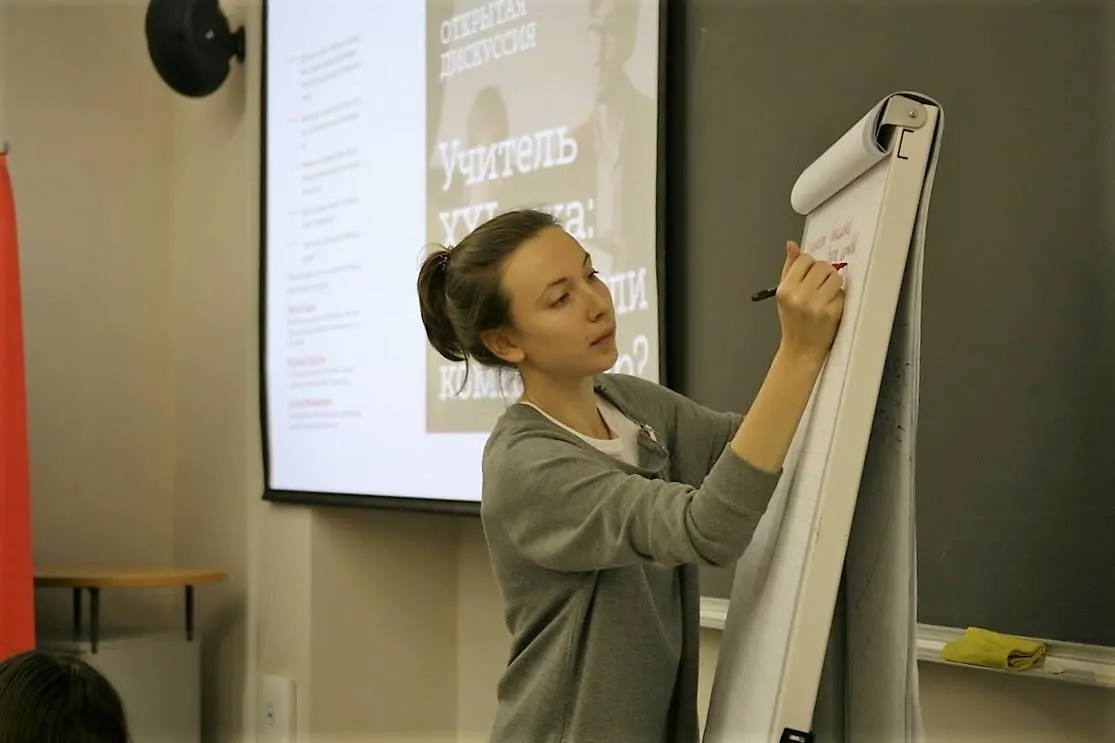
Zoya Suslova writing on a flipchart during a class
Zoya Suslova

An English teacher from St Petersburg who works with startup teams and corporate clients. She writes her own English courses around leadership, business and personal growth. She trained as a language teacher in Russia and has been a regular on education and exchange programmes with the US since school - she lived, studied and worked in San Francisco for several years. Then came a Russian-British master's in Moscow and international education projects. Today she lives in St Petersburg, works on social startups and teaches groups by methods of her own.

Facebook →
“Closed our first US deal in English.” - Anton, fintech “I run customer interviews myself now.” - Dasha, SaaS “Investor Q&A stopped scaring me.” - Pavel, marketplace “Our standups switched to English.” - Nadia, devtools “Closed our first US deal in English.” - Anton, fintech “I run customer interviews myself now.” - Dasha, SaaS “Investor Q&A stopped scaring me.” - Pavel, marketplace “Our standups switched to English.” - Nadia, devtools
I came because I froze on calls with US customers. Seven weeks later I ran the negotiation and closed our first deal - myself, no interpreter.
Anton - fintech founder
We broke down real user interviews from the YC playbooks, then role-played our own. Now I run customer development in English myself.
Dasha - SaaS co-founder
We went through as a team. Standups, reviews and messages default to English now. The final “gauntlet” was tougher than any board meeting.
Pavel - marketplace CEO

Your English is
your market cap.

“I stopped translating myself in my head somewhere around week four.”
a course graduate
Pricing

One seat in the cohort - everything included

Early bird
First 4 seats in the cohort
79 000 ₽
the full 7-week course
Standard
Cohort seat
Full access to everything
95 000 ₽
14 sessions + online cabinet + video courses
Cohort + Verba
A cohort seat plus 3 private Verba lessons
119 000 ₽
private work on your own calls and Q&A
A seat is held with a ₽15,000 deposit, credited to the price. Teams of 3+ and companies - invoice and contract available. A cohort just for your team? Write to us.
Next cohort
7 December 2026
Duration
7 weeks
Where
Strastnoi 12 + online
the classroom is the coworking
Level
B1+
Verba Native-speaker English · one-to-one

When you want your English - and no one else in the room

Verba is premium one-to-one tuition with a native speaker: an exam, negotiations, literature, or simply your own pace. A bespoke programme, a flexible schedule, full discretion. The cohort and Verba are two doors into the same English.

Ask about Verba →
Format 1-on-1
Start any time
First step free intro call
FAQ

Common questions

Is this a pitch course?
+

No. Polishing slides and the two-minute pitch is a separate intensive. Here we build the working English around your whole startup: customers, sales, Q&A, the team. When the language is yours, the pitch takes care of itself.

What level of English do I need?
+

A comfortable start is B1 and up - you can already put simple sentences together. Below that, begin one-to-one at Verba and join a cohort later.

Is it really based on Y Combinator?
+

We build the modules on the open videos, essays and playbooks of YC and other top accelerators, and train the English to do the same. We are not affiliated with YC - we learn from their public materials.

How many people are in a cohort?
+

No more than 12. Live lessons run as a full cohort; online practice happens in small groups of up to 4 so everyone gets maximum speaking time.

Can our whole team join?
+

Yes, and it works beautifully: a shared working English inside the team. For teams of 3+ and companies, we provide an invoice and contract.

How is this different from Verba?
+

Here you get a cohort, group energy and practice of real situations over 7 weeks. Verba is one-to-one lessons built around your personal goal and pace. Many take both.

Apply to the cohort

Ready to run your startup in English?

Send an application - we'll have a short call, understand your level and goal, and confirm your seat in the next cohort. There are only 12 seats.

The next cohort starts 7 December
Missed the twelve seats, or December doesn't suit?

Join the waiting list and we'll write when the next cohort opens.

Telegram and WhatsApp are fastest.
← Previous program Techstars Weekend Next program → Intensive for Startups
The dispatch A letter, occasionally. Cohort openings, party invitations, the odd confession. Once a fortnight at most, and never boring - we'd be too embarrassed.
The channels Hear it first. The Telegram channel gets everything first - dates, photos, the odd rumour. Everyone else is fashionably late.
The envelope Show us what you've got.